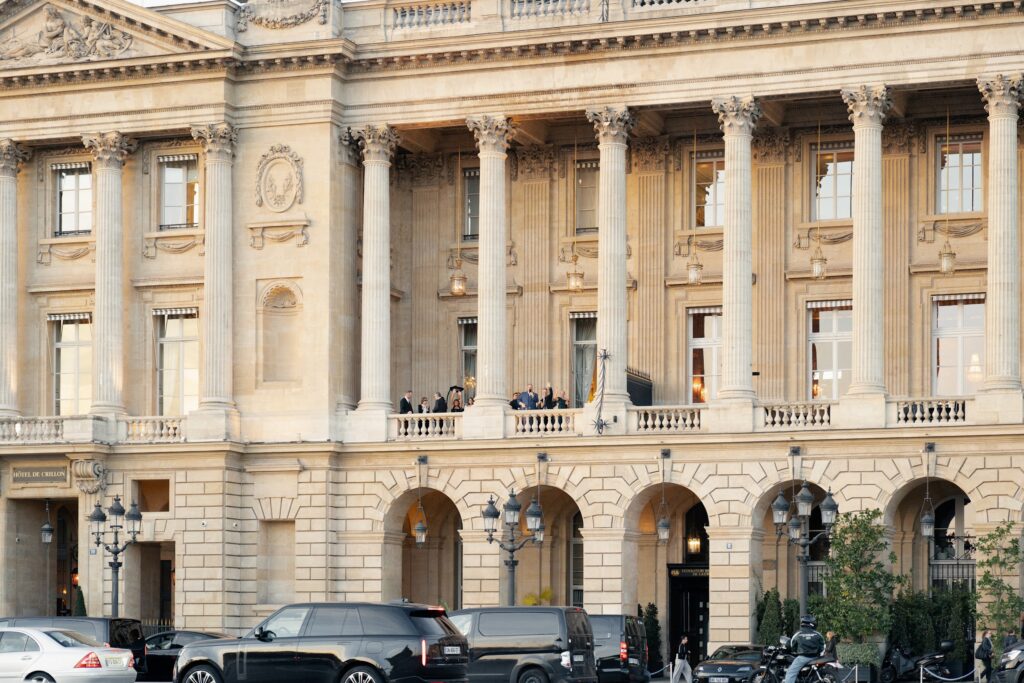
How to Choose the Perfect Wedding Venue in Paris
Choosing the right venue is one of the most important decisions when planning a destination wedding in Paris.
The venue will influence almost everything that follows: your wedding date, guest experience, design, catering, entertainment, transportation and, of course, your overall budget.
Paris offers an extraordinary variety of possibilities, from legendary palace hotels and elegant private mansions to rooftops overlooking the Eiffel Tower and historic reception spaces. Just outside the city, magnificent French chateaux provide another option for couples looking for privacy, gardens and a complete destination wedding weekend.
With so many possibilities, how do you choose the perfect wedding venue in Paris?
At CTH Events Paris, we begin by looking beyond beautiful photographs. A venue must not only correspond to your aesthetic vision — it must also work perfectly for your guest count, wedding programme, budget and logistical requirements.
Start With Your Wedding Vision
Before visiting venues, think about the experience you want to create.
Do you imagine an elegant Parisian palace wedding with your guests staying in the heart of the city?
A romantic ceremony overlooking the Eiffel Tower?
A private mansion with classical French interiors?
Or would you prefer to leave Paris behind and privatise a château for an entire weekend?
Your venue should reflect the atmosphere you want your guests to experience.
For inspiration, explore our guide to the best wedding destinations in France.
Define Your Wedding Budget
Your wedding budget is naturally one of the first considerations.
However, when comparing venues, it is important to look beyond the initial rental price.
Two venues with similar rental fees can ultimately have very different total costs.
One may include furniture, security, cleaning and several reception rooms, while another may require almost everything to be brought in separately.
Before making a decision, consider what the venue price actually includes.
Possible additional costs can include:
Tables and chairs
Lounge furniture
Tableware
Security
Cleaning
Cloakroom staff
Heating or air conditioning
Technical equipment
Lighting
Additional reception rooms
Ceremony fees
Extended event hours
Supplier access
Installation and dismantling days
Accommodation
Mandatory catering or beverage packages
Understanding these elements at the beginning makes it much easier to compare venues realistically.
Consider Your Number of Guests
Your guest count immediately eliminates some venues and makes others much more appropriate.
An intimate wedding for 30 guests can feel lost in a ballroom designed for 300 people.
Conversely, a venue that appears spacious in photographs may not work comfortably for 150 guests once dining tables, a dance floor, stage, bar and technical equipment are installed.
Do not look only at the maximum capacity published by the venue.
Ask how many guests can comfortably be seated in the configuration you actually want.
If you are expecting more than 150 or 200 guests, the choice of venues inside central Paris becomes more limited.
In that case, a château or large estate outside the city may offer significantly more flexibility.
Palace Hotel, Private Mansion or Chateau?
Each type of wedding venue offers a very different experience.
Paris Palace Hotels
A palace hotel is ideal for couples who want their guests to experience Paris without complicated transportation.
Accommodation, getting ready, ceremony, cocktail, dinner and dancing may sometimes be organised within the same property.
Hotels also provide established hospitality teams, catering and guest services.
For example, a Ritz Paris wedding offers the atmosphere of one of Paris’s most iconic addresses, with elegant reception spaces in the heart of Place Vendôme.
Private Mansions
A private mansion — or hôtel particulier — can create the feeling of welcoming guests into an elegant Parisian residence.
These venues often offer beautiful historical architecture, courtyards, salons and gardens while remaining more private than a hotel.
However, they may require more external suppliers for catering, furniture, production and staffing.
French Chateaux
For couples who want privacy, outdoor spaces and several days together with their guests, a château can be an excellent alternative.
Many estates offer gardens, multiple reception spaces and possibilities for a welcome dinner, wedding celebration and farewell brunch.
A château wedding also gives international guests the opportunity to discover another side of France while remaining relatively close to Paris.
Think About the Location
A beautiful venue can become complicated if the location does not work for your guests.
Consider where most guests will be staying and how they will travel to and from the celebration.
For a central Paris wedding, guests may be able to use taxis or private cars easily.
For a château outside Paris, organised transportation is usually preferable.
We also consider:
Distance from Charles de Gaulle Airport
Distance from central Paris
Nearby hotels
Coach access
Parking
Late-night transportation
Travel time after the celebration
Accessibility for elderly guests
Transportation should be incorporated into the wedding plan from the beginning rather than treated as an afterthought.
Accommodation for Your Guests
If most of your guests are travelling internationally, accommodation becomes an important part of venue selection.
A Paris hotel wedding provides the convenience of having at least some guests staying directly at the venue.
A château may offer bedrooms on the estate, but the number can range from only a few rooms to accommodation for a large part of the guest list.
When on-site accommodation is limited, we create a selection of nearby hotels at different price points and organise transportation between them and the wedding venue.
Ceremony Possibilities
Where will you actually get married?
This question should be answered before signing a venue contract.
You may dream of an outdoor ceremony, but you need to know exactly where it can take place and how many people the space accommodates.
Think about:
Garden ceremonies
Historic salons
Courtyards
Terraces
Eiffel Tower views
Religious ceremonies
Symbolic ceremonies
Indoor alternatives in case of rain
The ceremony setting should feel intentional and beautiful in both the ideal scenario and the Plan B.
Always Check the Plan B
This is one of the most important questions we ask during venue visits.
What happens if it rains?
A beautiful garden is not enough.
If 120 guests are invited to an outdoor ceremony, the venue needs an indoor space capable of accommodating those same 120 people elegantly.
The Plan B should not feel like an emergency solution.
It should be a setting you would genuinely be happy to use.
This is particularly important for destination weddings because weather decisions often affect flowers, furniture, musicians, catering and the entire installation schedule.
Cocktail Reception
The cocktail reception deserves its own space.
After the ceremony, guests should be able to relax while enjoying champagne, canapés and entertainment without watching suppliers transform the ceremony area into the dinner space.
Ideally, the venue provides several distinct environments.
For example:
Ceremony → gardens → cocktail terrace → dinner salon → party room
This progression gives the wedding rhythm and creates a sense of discovery throughout the day.
Wedding Dinner
When visiting a venue, imagine the room completely set for dinner.
Where will the tables go?
Where will speeches take place?
Can every guest see the couple?
Is there enough space between tables for service?
Can floral arrangements be installed safely?
Where will the catering team operate?
Will the room still feel beautiful once it contains the actual number of tables required?
These practical details often make the difference between a venue that photographs beautifully and one that genuinely works well for a wedding.
Dinner and Dancing
Not every beautiful dinner venue is suitable for a party.
If dancing is important to you, ask about it before booking.
Some historic venues have strict sound limits or require music to finish relatively early.
Others have a separate room where guests can continue dancing later.
Ask:
Where can the DJ or band perform?
Is there space for a stage?
Is a dance floor required?
What are the sound restrictions?
What time must amplified music stop?
Can doors and windows remain open?
Are additional soundproofing measures required?
For couples who want an energetic late-night celebration, these questions are essential.
Furniture and Equipment
Always ask what is included.
A venue may appear attractively priced until you discover that tables, chairs, dinner furniture, outdoor furniture and technical equipment all need to be rented separately.
Alternatively, a venue may include furniture that does not correspond to the style of your wedding, meaning replacement rental is still required.
Knowing this before booking allows the design and budget to be planned correctly.
Catering and Beverages
Some venues work exclusively with their own caterer or hotel kitchen.
Others provide a list of approved caterers.
Some allow you to choose freely.
None of these models is inherently better, but they affect both the budget and the creative possibilities.
If gastronomy is particularly important to you, understand the catering conditions before committing to the venue.
The same applies to beverages.
Ask whether champagne, wine and spirits must be purchased through the venue or whether an external provider is permitted.
Supplier Access and Installation
One of the most overlooked aspects of venue selection is installation time.
A complex wedding may require florists, furniture suppliers, production teams, lighting technicians, musicians and caterers to work on site before guests arrive.
Ask:
When can suppliers enter?
Is installation possible the previous day?
Is early-morning access permitted?
Is there a loading entrance?
Can trucks reach the venue?
Is there a lift?
Are there restrictions on floral installations?
When must everything be removed?
A venue with beautiful spaces but only two hours of supplier access can create significant additional logistical costs.
Think About the Wedding as a Complete Experience
The perfect wedding venue is not simply the room where dinner takes place.
Consider the entire guest journey.
Where will they arrive?
What will they see first?
Where will they wait before the ceremony?
How will they move to cocktail hour?
When will they discover the dinner room?
Where will they dance?
How will they leave at the end of the night?
When these transitions are planned well, the celebration feels effortless.
Paris or the French Countryside?
Some couples begin their search convinced that they want to marry in Paris and eventually fall in love with a château.
Others initially imagine a countryside estate but realise that the convenience and energy of Paris suit their guests better.
Both options can create extraordinary destination weddings.
Paris offers iconic architecture, luxury hotels, museums, private mansions and Eiffel Tower views.
The countryside offers privacy, gardens, greater space and the possibility of bringing everyone together for several days.
If you are still deciding, our guide to a fairytale wedding in France explores several different styles of celebration.
Questions to Ask Before Signing a Wedding Venue Contract
Before committing to a venue, make sure you understand:
Exactly which spaces are included
Rental hours
Installation hours
Dismantling requirements
Guest capacity by configuration
Rain plan
Music restrictions
End time
Furniture included
Catering requirements
Beverage requirements
Security costs
Cleaning costs
Staff requirements
Parking
Transportation access
Accommodation
Supplier restrictions
Technical limitations
Cancellation conditions
A beautiful venue is only the beginning.
The contract determines what you can actually create there.
Planning Your Paris Wedding Venue Search With CTH Events Paris
Finding the right venue is one of the first stages of our wedding planning process.
We begin by understanding your guest count, budget, preferred date, priorities and the experience you want to create.
We can then identify locations that genuinely correspond to your project rather than sending an endless list of beautiful venues.
Our role may include:
Wedding venue research
Shortlisting suitable locations
Venue availability checks
Venue visits
Comparison of proposals
Budget analysis
Review of practical requirements
Guest accommodation planning
Transportation logistics
Wedding design possibilities
Supplier requirements
Wedding-day flow
Contract coordination
Once the venue has been selected, the rest of the wedding can be designed around it.
You can also explore our complete selection of luxury wedding venues in Paris and France.
Frequently Asked Questions About Choosing a Wedding Venue in Paris
How Far in Advance Should We Book a Wedding Venue in Paris?
For a destination wedding, beginning the venue search approximately 12 to 18 months before the wedding is generally advisable.
Popular Saturdays and highly sought-after venues may require even earlier planning.
How Many Guests Can Paris Wedding Venues Accommodate?
It depends greatly on the venue.
Paris offers intimate salons for small celebrations as well as larger hotels and event spaces, but options become more limited for very large seated weddings.
For larger guest lists, a château outside Paris may provide more flexibility.
Should We Choose Our Venue Before Our Wedding Date?
If you have flexibility, yes.
Many couples select a preferred season or several possible dates and then choose the final wedding date according to the availability of their favourite venue.
This gives you a much wider choice.
Is a Paris Wedding More Expensive Than a Chateau Wedding?
Not necessarily.
The final cost depends on what is included in the venue, catering requirements, guest count, accommodation, transportation, furniture and production.
A venue with a higher rental fee may ultimately cost less if many services are already included.
Can We Organise an Outdoor Wedding in Paris?
Yes, depending on the venue.
Private gardens, terraces and courtyards can provide beautiful outdoor settings.
However, a suitable indoor alternative should always be available.
Can CTH Events Paris Help Us Find the Venue Before We Book Full Planning?
Venue search can be part of our wedding planning services. The exact scope depends on the type of support required and the stage you have already reached in your planning.
Find Your Perfect Wedding Venue in Paris
Choosing your wedding venue is the moment when your destination wedding begins to feel real.
The right venue should inspire you, but it should also work beautifully for your guests, your budget and the celebration you want to create.
Whether you dream of a palace in central Paris, an intimate private mansion, an Eiffel Tower view or a French château surrounded by gardens, CTH Events Paris can help you find the setting that makes sense for your wedding.
Your perfect venue is not simply the most beautiful one.
It is the place where your entire celebration can come together.